
Niobe answers from your own technical library — cited to the page, spoken hands-free, running on hardware you control. No signal required. No upload required.
TRL 4 · demonstrator measured 22 Aug 2026 · CMMC Level 2 self-assessment in preparation, no third-party certification claimed
“How do you treat heat exhaustion?” — ask it above and the answer comes back from the manual itself, with the page. Try something it does not cover, too: refusing is the part worth testing.
Your question is not stored. We keep a daily count of how often this box answers, refuses, or finds only related material — not what was asked. Rate limiting uses a token that rotates every hour, never your address.
Two publicly released U.S. Navy manuals are loaded: NAVEDTRA 14150 (Machinist’s Mate 1 & C) and NAVEDTRA 14295 (Hospital Corpsman).
Cited procedure steps at the point of work, grounded in your own unclassified library, running fully air-gapped. Entity, registration and cybersecurity posture stated plainly — including what is not yet in place.
Entity & readiness → Solo & small businessThe same engine, pointed at the work that repeats — inbox, follow-ups, quotes, paperwork, the opportunities you never get time to chase. You can run it yourself today.
What it handles →A shipboard technician, an elevator mechanic, and a firm whose files can't leave the building have the same problem in different clothes: the right procedure, at the point of work, without stopping to go find it.
The tech climbs back up, finds the binder, climbs back down. Twice. The repair takes four hours instead of one, and the fix depends on what he remembered on the ladder.
Zero bars, gloves on, a schematic he'd need three hands to hold. So he guesses, or he calls the one person in the company who knows — if they pick up.
The firm has twenty years of precedent on a server. Every useful AI tool starts with “upload your documents,” and that sentence ends the conversation.
Your files, read on your own hardware. There is no upload.
Job sites, vessels, basements — Niobe Edge stays on.
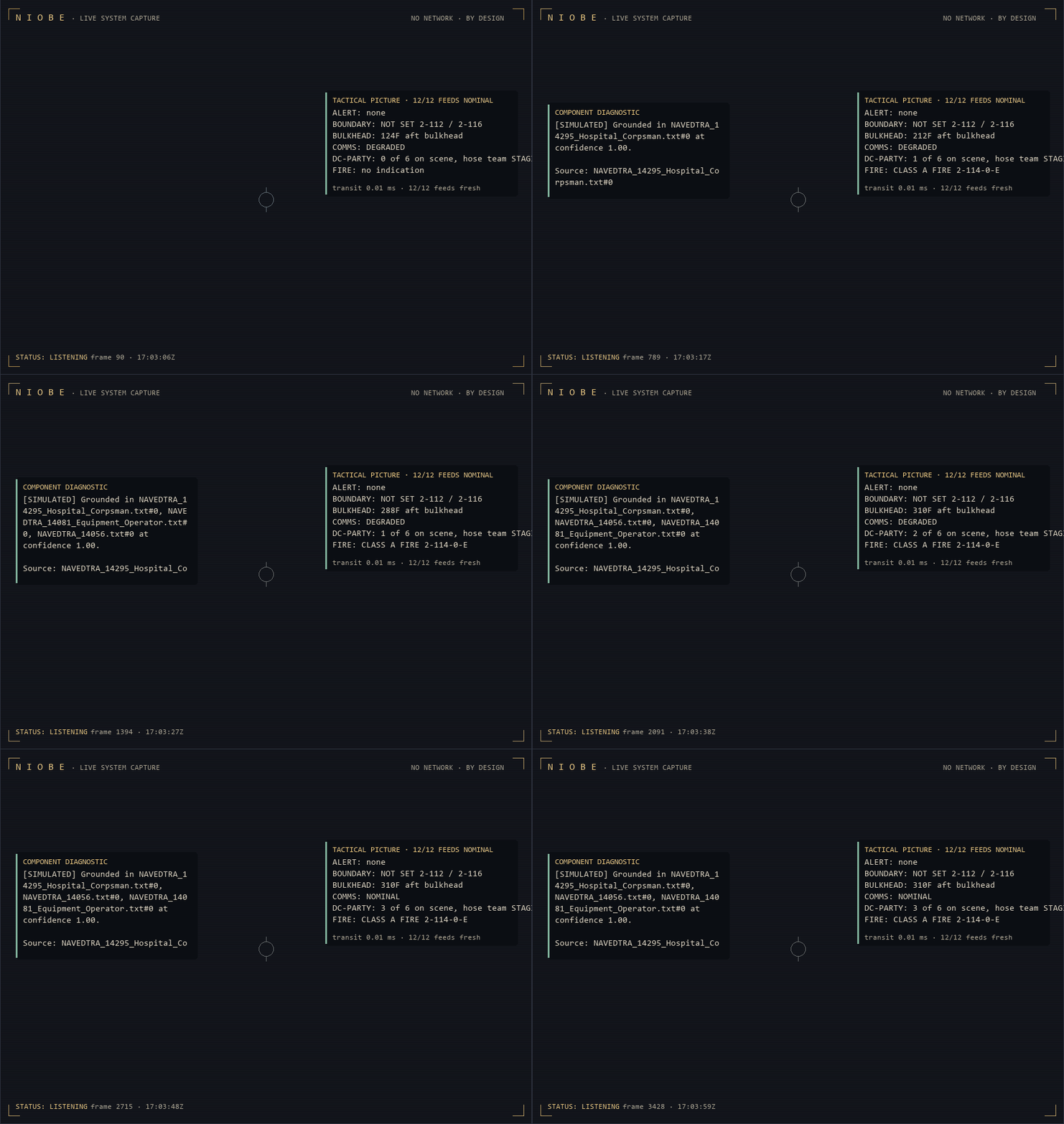
Recorded from the working system. The answer on the left is cited to NAVEDTRA 14295 — a real, publicly released U.S. Navy training manual — while twelve live readings refresh on the right. Simulated sensors, real software, zero network.
Generic AI works like a stranger who just met you. It forgets you by the next session.
A deep interview maps how you think, decide, and move — then it indexes your technical library — manuals, standards, schematics, procedures — however large it happens to be. It sharpens with every correction and never makes you re-explain yourself again.
Then it goes to work, hands-free — hunts your next contract, clears the admin, overlays live procedure steps on a heads-up display, and ships the work in your voice. You wake to things done, not a to-do list.
One demonstrator run, reproducible from the source repository, with the conditions stated rather than footnoted.
The suite runs with no model present, so a green result is the architecture, not a lucky generation.
Sensor → bus → fusion → emit, against a 30 ms budget. 34 samples, zero breaches.
And 19/19 legitimate prompts passed. A system that refuses everything is broken, not safe — the second number is what separates them.
Hash-chained HUD emissions, zero dropped sensor readings.
What this run does not show. It executed on a development workstation using recorded sensor replay and stubbed inference. It demonstrates that the architecture holds its latency budget and that the refusal controls fire. It does not demonstrate on-device performance — latency and endurance with a quantized model on target headset hardware are unmeasured, and establishing them is Phase I work. We assess the system at TRL 4. We hold no third-party assessment and claim none. And we have no completed customer deployment — you would find that out in diligence, so you should find it out here. See the full run →
Sensor state reaches the display on a fixed cadence against a 30 ms budget, whether or not anyone is asking a question. Readings that go stale are labelled stale — never drawn as live.
Answers are retrieved from your ingested library and returned with the document and the page. If your library doesn't cover it, Niobe says so instead of guessing. The obvious design — one loop that thinks, then draws — freezes the operator's picture for the length of every inference. We built that version and rejected it.
Including what is not yet in place. Every value here is generated from a single status file and verified against it before deploy. The entity was formed on 20 August 2026; the engineering predates it. We would rather you read both facts here than discover them later.
NIOBE runs on what you already own — your phone and your earbuds — and on local edge hardware when the job leaves coverage. Heads-up display streaming for AR smart glasses is built in, not bolted on. See Niobe Edge →
“Niobe ran my own business for months before I offered it to anyone. It caught a duplicate charge and a grant deadline I would have missed — that’s the day I knew it was real. I built it for myself first. Now it learns you.”
A paid 30-day pilot comes first. We agree in writing what has to be true for it to have worked. If it does not hit those criteria, there is no deployment for us to sell you.
We would rather lose the sale. If your library does not cover the work, we say so on the scoping call — before anyone signs anything. That is a cheaper answer for both of us than a deployment that stalls.
Bring one repair or one procedure that keeps going wrong. We will tell you honestly whether your library covers it — including if it doesn't.